
Drop test simulation predicts how a product responds to a fall by solving the impact on a computer, before a single prototype exists. It uses explicit dynamics finite element analysis to reproduce the milliseconds of a drop, then reports the stress, deformation, and safety margin at every point in the part. The result is a design decision backed by data, not a broken sample and a guess about why it failed.
That distinction matters. A physical drop shows you what broke. A simulation shows you why, how close every other component came to breaking, and what to change so it does not happen again.
Key Takeaways
The short version
- Drop test simulation solves a fall with explicit dynamics FEA, so you see stress and plastic strain across the whole part, not just the piece that failed.
- Explicit solvers such as LS-DYNA and Abaqus/Explicit are built for high-speed, short-duration events where inertial forces dominate.
- One model can replicate the load cases in MIL-STD-810, ISTA, and ASTM protocols, then vary drop height, angle, and floor stiffness without building another sample.
- Simulation shows design margin. A physical drop only tells you pass or fail at the limit.
- Simulating first cuts prototype and tooling cost and gets products to market faster.
What is drop test simulation?
Drop testing evaluates a product’s ability to withstand being dropped, and a drop test simulation reproduces that same event inside a solver instead of on a lab floor. As Zebra Technologies puts it, a physical drop test releases a product in free fall a set number of times, from a fixed height, onto a flat surface, and drop tests “are just a way to simulate real-world accidents.” A simulation performs that same experiment numerically: the software drops a digital twin of the part, computes the contact, and tracks how energy moves through the structure.
XCEED Engineering builds these models as part of its non-linear, explicit finite element analysis work. The firm specializes in the simulation of rapid, transient events such as automobile impacts, drop tests, and blast effects, using explicit code to solve them quickly and accurately. If you are new to the method itself, our primer on what finite element analysis is covers the fundamentals a drop model is built on.
How explicit dynamics FEA models a drop
The solvers behind a drop test simulation, such as LS-DYNA and Abaqus/Explicit, use explicit time integration for highly nonlinear, transient dynamic problems. As the LS-DYNA reference notes, the method is built for “high speed, short duration events where inertial forces are important,” and drop testing sits on its list of core applications alongside crash, ballistic impact, and shipping container design.
Here is what that means in practice. An implicit static solver is comfortable when loads are applied slowly. A drop is the opposite: contact happens in a few milliseconds, materials yield, parts snap together and bounce apart. An explicit solver marches forward in tiny time steps, often on the order of a microsecond, resolving contact and material behavior at each one. That is why it captures a bouncing latch or a buckling wall that a static analysis would miss entirely.
A credible model needs three things right. The mesh has to be fine enough where stress concentrates, such as corners, ribs, and snap features. The material model has to include real stress-strain data past yield, because plastics and metals behave very differently once they deform permanently. And the contact definition has to reflect the real floor, whether that is concrete, plywood over concrete, or a padded surface.
What a drop test simulation shows that a physical drop cannot
A physical drop only reveals damage you can see. When a product hits the ground, you get a pass or a fail, and if you are lucky, some visible cracking. Everything happening inside the material stays hidden. A simulation removes that blindfold, which is the core argument in our breakdown of the reasons to use FEA over physical drop testing.
The biggest gain is the full stress spectrum. Once a material yields, it can never return to its original shape, and each large stress deforms it a little more until it finally breaks. A drop test picks that up only at the limit. A simulation shows the stress everywhere, on every component, at every instant, so you can see which part is closest to failing even when nothing visibly broke.
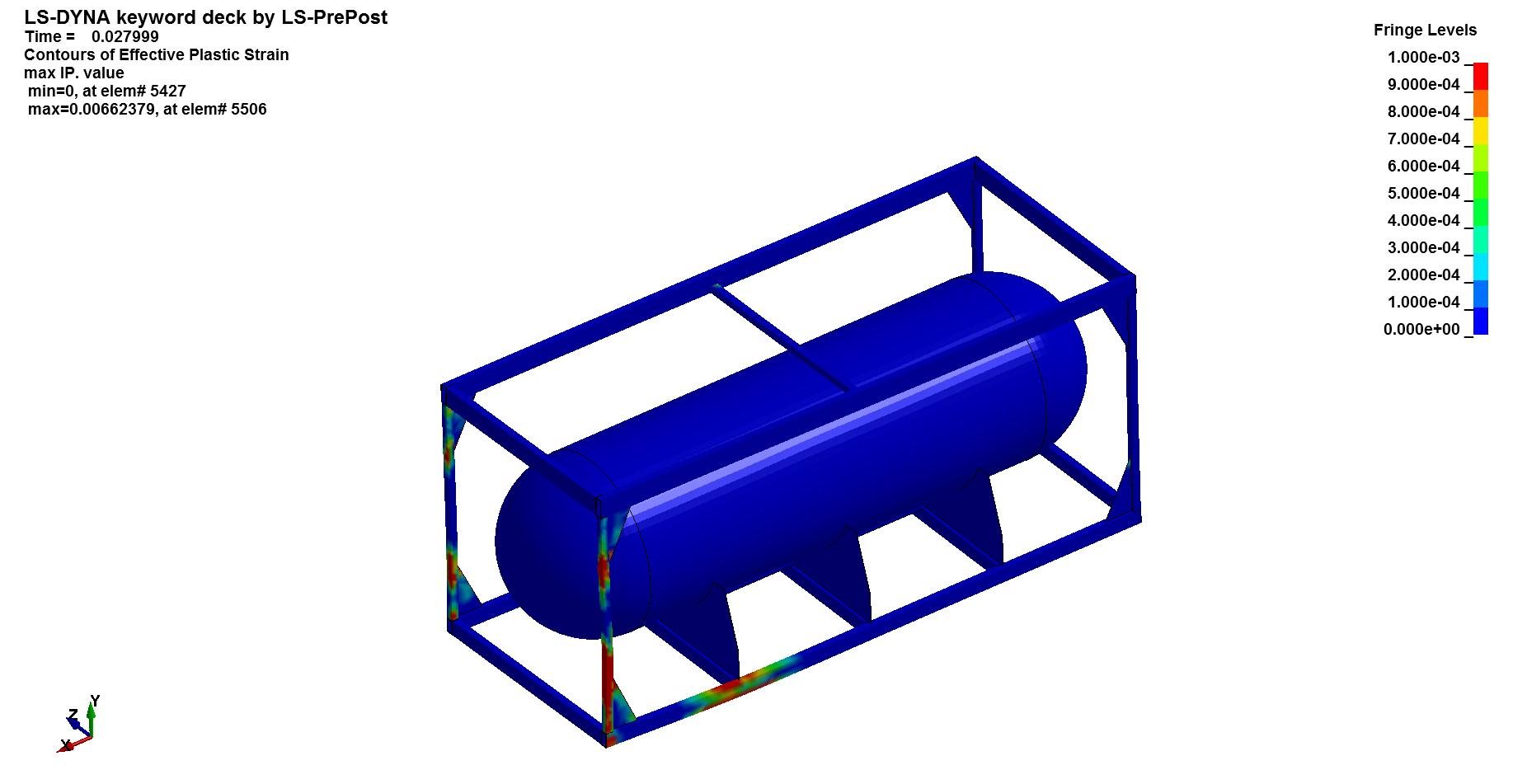
The data is also cleaner. Instrumenting a small product with accelerometers introduces its own error, because the mass of the sensor changes the center of gravity of a light part and skews the reading. A model has no such problem. It also lets you see design margin directly. In XCEED’s shipping container impact analysis, a four-foot corner drop of a hazardous-material tanktainer showed exactly where plastic strain concentrated, near the saddle and the vertical support, so the design could be iterated to cut peak stress before anything was built or tested.
Which standards a drop test simulation can replicate
Most drop testing follows a published protocol, and a simulation can reproduce the same load cases. Under MIL-STD-810 Method 516, per Zebra’s summary, a device is dropped 26 times, distributed as 8 corner drops, 12 edge drops, and 6 face drops across a set of test units. Reproducing all 26 events physically consumes multiple samples. In a model, each drop is a separate load case run on the same mesh.
E-commerce packaging follows a different family of standards. The ISTA 6-Amazon.com Over Boxing protocol covers packaged products weighing 70 lb (32 kg) or less, and its free-fall drop testing simulates the impacts a parcel sees during handling, sorting, loading, unloading, and last-mile delivery. ASTM D5276 defines a comparable free-fall drop of loaded containers. Whatever the protocol, the value of simulation is speed of iteration: you can vary drop height, impact angle, impactor stiffness, and even the contents of a case, and rerun each condition on the same model instead of building a new sample for every one.
When you should run a drop test simulation
Shipping damage is common enough that catching it early pays for itself. Roughly 3 to 4 percent of parcels arrive damaged in the United States, which added up to about 85 million packages in 2024, and industry data compiled by Opensend reports that 51 percent of consumers are unlikely to buy again after a damaged delivery. A single field failure can cost far more than the analysis that would have prevented it.
Drop test simulation earns its place whenever a physical prototype is expensive, slow, or risky to build. Injection-molded parts are a clear case, because a mold can cost tens of thousands of dollars before you drop a single sample. Consumer electronics, medical devices, defense equipment, and specialty shipping containers all fit the same pattern. It is also the right tool early in development, when the design is still moving and you want to compare options before committing to tooling. XCEED builds these models from a client’s CAD geometry, then sweeps the conditions from there: a new drop height, a different impact angle, a stiffer floor, each one run on the same mesh.
How to choose a drop test simulation partner
Experience with explicit dynamics is the dividing line, and it is where a strong partner pays back. XCEED’s combination of FEA, delegated design, and 3D CAD has reduced project costs and timelines by up to 25 percent for clients, which is the kind of result that only comes from engineers who have run these transient models before. Explicit solving is unforgiving of a coarse mesh, a missing material curve, or a sloppy contact definition, and small mistakes produce confident, wrong answers.
When you evaluate a firm, ask how they source post-yield material data, how they correlate a model to physical results, and which standards they routinely reproduce. Look for a team that treats the simulation as an engineering deliverable, not a colorful picture. If you want to talk through a specific part, our mechanical engineering group handles drop and impact work directly, and you can contact XCEED to scope a project.
Frequently Asked Questions
Is drop test simulation accurate enough to replace physical testing?
A well-correlated model predicts stress, deformation, and failure location closely enough to drive design decisions and cut the number of physical drops needed. Many teams still run a final physical test for certification, but they enter it already confident, because the simulation found the weak points first.
What software is used for drop test simulation?
Explicit dynamics solvers such as LS-DYNA and Abaqus/Explicit are the standard tools, because they are built for the short-duration, high-speed contact of an impact. The choice depends on the material, the geometry, and the standard being replicated.
What drives the schedule on a drop test simulation?
Most of the schedule goes into building the model: cleaning up the CAD geometry, sourcing post-yield material data, and defining the contact with the floor. Once that model exists, additional load cases such as a new drop height or a different impact angle run much faster, because they reuse the same mesh and material setup. Ask the firm for a schedule against your specific geometry and acceptance standard.
What do you need to start a drop test simulation?
A CAD model of the product, the materials involved, the drop conditions you care about (height, orientation, and floor type), and the standard or acceptance criteria you are designing to. With those in hand, an engineer can build the model and start reporting results.
Written by the XCEED Engineering Team.